Ask a room of MSP owners whether they would rather host their own tools or pay someone else to, and you will get a proper argument. Both camps are right. The answer depends on what you are protecting, what your clients need from you, and how much of your week you want to spend looking after a server.
Here is how we would think it through.
What you are really choosing
The software is usually the same either way. What changes is who looks after the machine it runs on: the operating system, the database, the certificates, the backups, the monitoring, and the upgrades. With a hosted service, that is the vendor's job. When you self-host, it is yours.
So the question is not "which is better". It is "who do I want responsible for this server, and what do I get in return for taking it on?"
Control
Self-hosting gives you the most control. You choose the hardware or the cloud account, the network it sits on, who can reach it, and when it changes. If you want the platform on a private network with only your office and your agents able to reach it, you can do that.
You also choose when to upgrade. Some MSPs like to read the release notes, test on a spare box, and upgrade on a quiet Sunday. Others would rather never think about it. Neither is wrong.
Hosted gives up some of that control in exchange for not having to exercise it. Updates arrive for you, and somebody else is watching the server at 03:00.
Compliance and data residency
For some MSPs this decides it. If you look after clients in regulated sectors, or you have promised a client that their data stays on infrastructure you control, self-hosting makes that easy to show: the data is on your server, in your country, under your policies.
Hosted can still be the right answer here, as long as you understand where the data lives, how it is separated from other customers, and what the provider's data processing agreement says. Ask for those things in writing. A dedicated instance with its own database is a much easier conversation with a client's auditor than a shared one.
Either way, write down where your platform runs and include it in your own documentation and client agreements. Clients increasingly ask.
The real cost of running it yourself
The licence price is the easy part to compare. The cost people underestimate is time. Running your own server properly means:
- Patching the host. Operating system and container updates, and restarts, on a schedule.
- Backups. Of the database and the keys, stored somewhere other than the server, and restore tests to prove they work.
- Monitoring. Disk space, memory, certificates, and whether the thing is up at all.
- Upgrades. Reading release notes, backing up first, running the upgrade, checking it worked.
- Security. Firewall rules, access to the box, and keeping secrets such as application keys safe.
Put some rough numbers on it as an illustration. An hour a month on host patching, an hour a month checking backups and monitoring, and half a day a quarter for an upgrade and a restore test comes to 2 hours times 12, plus 4 hours times 4: about 40 hours a year. Price that at your own hourly rate and add the server itself, and you have a fair figure to put beside the hosting premium.
Some MSPs look at that and happily take it on. Running servers is what you do all day, and your platform is another one on the list. Others would rather spend those 40 hours on clients. Both are sensible.
Questions that usually settle it
- Do any of your clients or contracts require the data to stay on infrastructure you control?
- Do you already run servers with patching, backups and monitoring in place?
- Who covers it when the person who set it up is on holiday?
- Would you rather choose your upgrade dates, or never think about them?
- How quickly do you need to be up and running?
If most of your answers point at control and you already run infrastructure well, self-host. If they point at time and simplicity, go hosted.
How we handle it in Tenvara
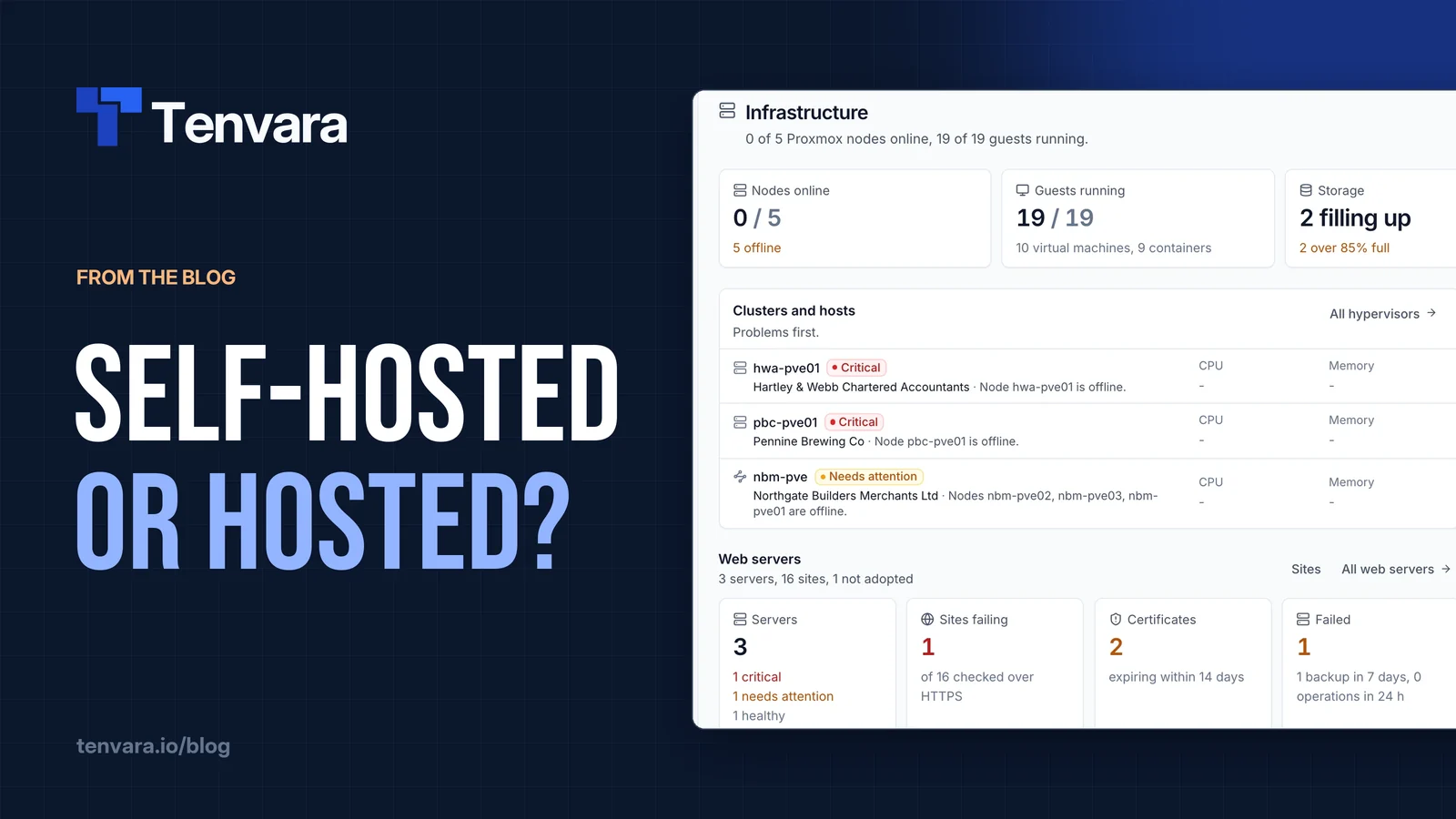
Tenvara is the same product either way: it is available hosted or self-hosted, with identical features. What differs is who looks after the server. The comparison is on the hosted or self-hosted page.
Hosted by us gives you a dedicated instance at yourname.tenvara.app with its own database. We look after the server, its operating system and security updates, Tenvara updates, TLS certificates, and backups and monitoring of the instance. Storage for your customers' backups is provided, or you can point backup at your own S3 compatible storage. For hosted instances we act as your processor under UK GDPR and EU GDPR, with a data processing agreement. The hosted onboarding guide walks through ordering and first sign-in.
Self-hosted is one Docker Compose install per MSP on a Linux server you run, in your office, your data centre or your cloud account. A licence key from your account switches it on. The compose file brings up the whole stack, including Postgres, Redis and MinIO, with Caddy handling TLS automatically. You upgrade when it suits you: back up, set the version, pull and restart. The self-hosted install guide is honest about the work too: which volumes to back up off the server, and why the backup master key needs its own copy somewhere safe.
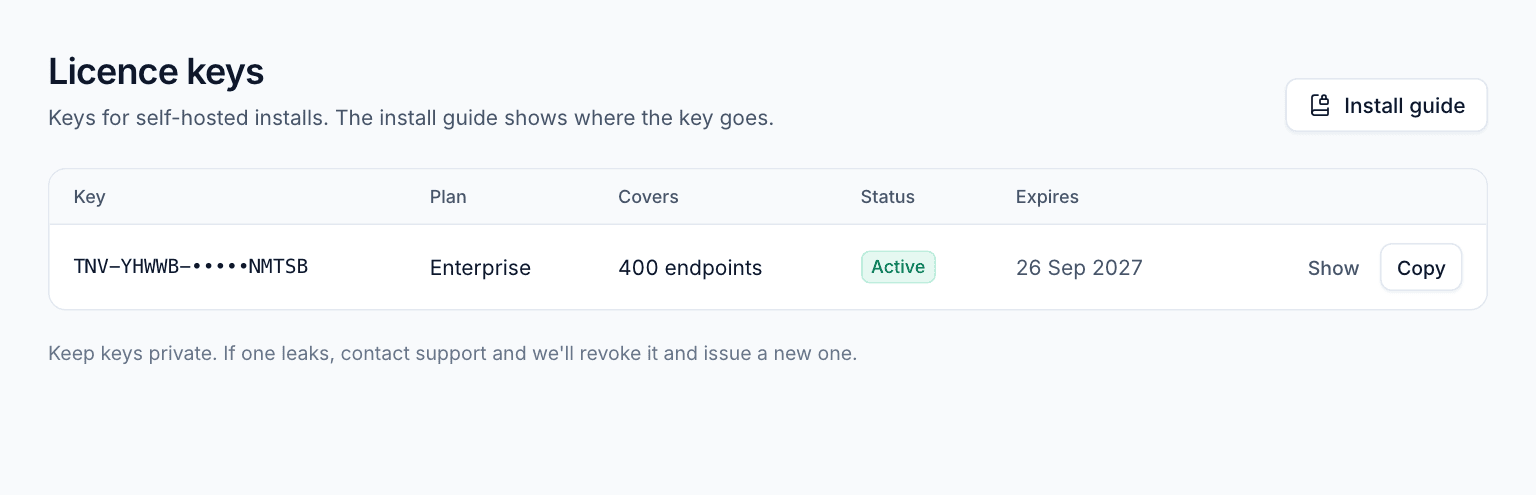
If you are not sure yet, you don't have to decide on day one. The product is the same either way, so you can judge the features first and choose where it lives afterwards.
Both are good choices
There is no wrong answer here, only a trade between control and time. Be honest about how much server care you want on your plate, check what your clients need, and pick the one that fits. Tenvara is launching soon: get early access to apply for the beta or hear when it launches.