Compare: RMM and patching
NinjaOne alternative: Tenvara
NinjaOne is a popular cloud RMM that many MSPs use for monitoring, patching and remote support, and it now adds backup, documentation and ticketing. Tenvara does the same device work with one agent for Windows, macOS and Linux, in the same app as your service desk, Microsoft 365 management, security and quoting. You can use it hosted or run it on your own server.
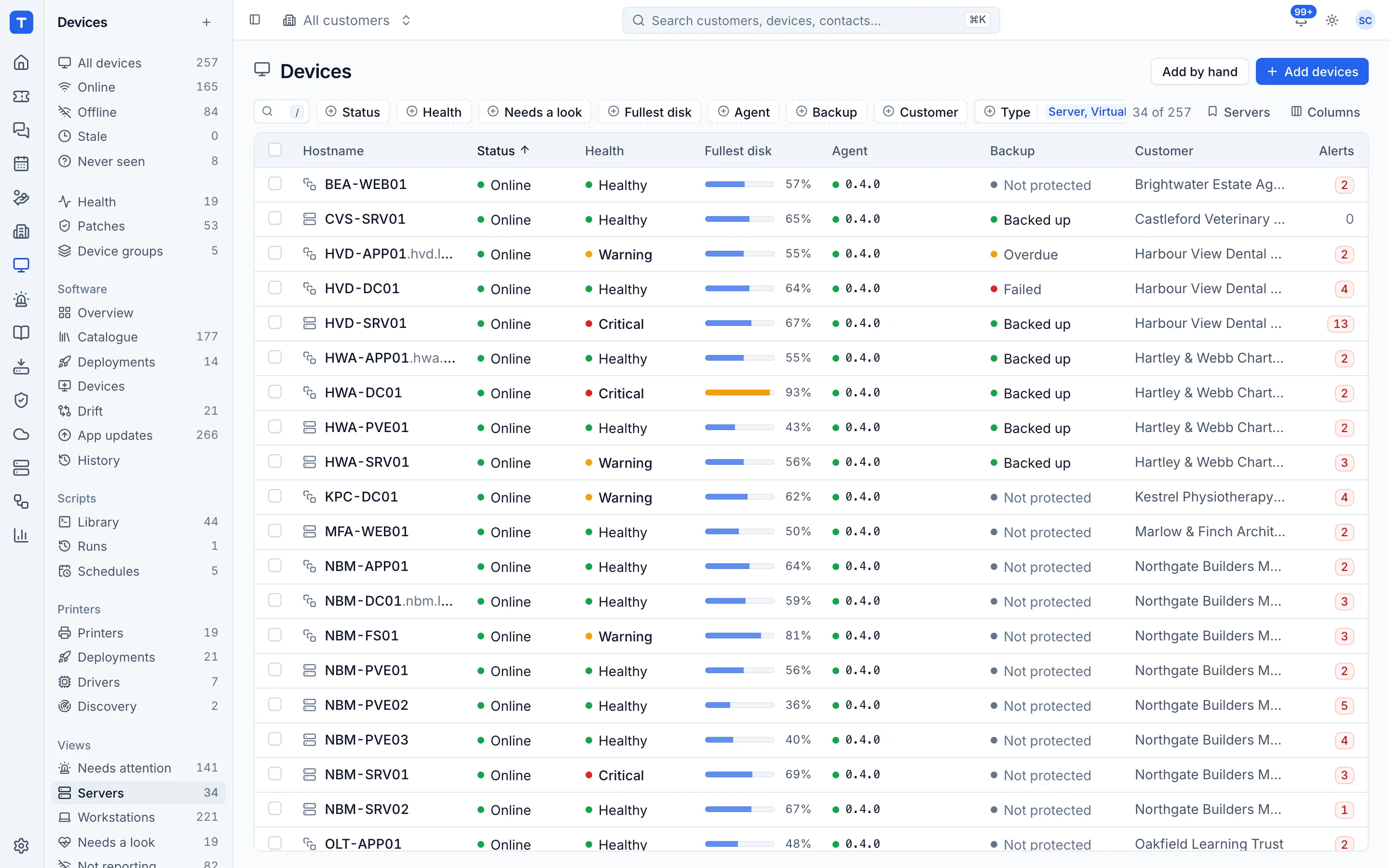
The tool today
What NinjaOne does
Cloud RMM that has grown into patching, backup, remote access, documentation and a PSA. Made by NinjaOne. This is how the vendor describes it, in our words.
- Monitors Windows, macOS and Linux devices, with alerts on performance, services and applications.
- Patches operating systems and auto-updates over 200 third-party applications.
- Monitors network devices such as printers, firewalls, routers and switches, and includes mobile device management.
- Offers NinjaOne Backup for servers, workstations, Microsoft 365 and Google Workspace, in cloud, local or hybrid set-ups.
- Has built-in documentation, and NinjaOne PSA for ticketing, contracts, time tracking and billing.
- Has a mobile app for managing endpoints on the go.
Side by side
Tenvara vs NinjaOne
The RMM and patching jobs that matter most, and how each product handles them.
Agent for Windows, macOS and Linux
Windows, macOS and Linux
Monitoring, checks and alert thresholds
Custom alerts on performance and services
Operating system and third-party patching
OS patching plus 200+ third-party apps
Remote control
Several remote access options
Scripts and automation
Remote scripts and task automation
Device and Microsoft 365 backup
NinjaOne Backup, including SaaS backup
Add-on means the vendor sells it as a separate product or paid extra. NinjaOne details come from the vendor's own website, see sources.
The one-app pitch
What else you'd replace
Most MSPs running NinjaOne pay for several other tools beside it. Tenvara does these jobs too, on the same customer record, with one agent and one login.
See every comparisonSwitching
Moving from NinjaOne
A calm move, not a big bang. Run both side by side until your team is happy.
-
1
Set up customers and sites
There is no automatic import from NinjaOne, so add your customers and sites first. Enrolment tokens then tie each device to the right customer.
Customers, sites and contacts -
2
Recreate your policies
Set monitoring checks, thresholds and patch policies at global, customer and device group level. The defaults suit most MSPs, so you may only need a few changes.
Policies, checks and thresholds -
3
Deploy the agent alongside
The one-line install command runs from any tool that can run a script, including NinjaOne, so you can roll Tenvara out to a whole customer at once.
Installing the agent -
4
Bring your scripts across
Add the scripts you rely on to the library, with parameters. PowerShell, Batch, Bash, Zsh and Python are supported.
The script library -
5
Run both side by side, then switch
Compare alerts and patch results for a few weeks, then remove the NinjaOne agent customer by customer.
NinjaOne pricing
NinjaOne prices by quote, with some starting figures on its website. Check its pricing page for current prices.
Vendor pricing pageTenvara pricing
One subscription, per technician or per endpoint, hosted or self-hosted, with every feature in every plan.
See pricingQuestions
NinjaOne vs Tenvara: FAQ
Yes. It patches Windows, macOS and Linux, and updates apps from its software catalogue through winget, Homebrew, apt and dnf, in the same maintenance windows.
Yes. Use a hosted instance, or run it with Docker Compose on your own Linux server. The features are the same either way.
More RMM and patching comparisons
See Tenvara next to NinjaOne.
A 30 minute walkthrough of the real product. Bring your list of what you use today and we'll show you where each part lives in Tenvara, and where it doesn't.
Comparison based on publicly available information as of September 2026. NinjaOne is a trademark of its owner; Tenvara is not affiliated with it. Spotted something out of date? Tell us and we'll correct it.
Sources